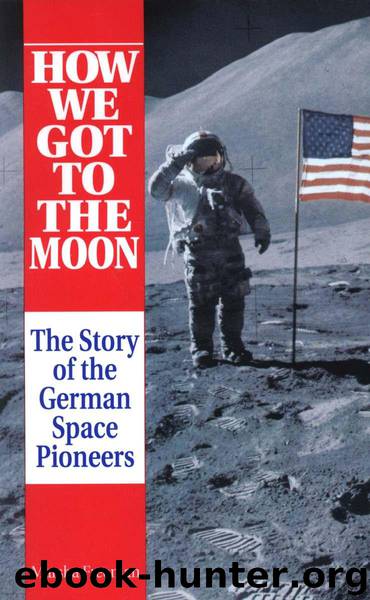
How We Got to the Moon: The Story of the German Space Pioneers by Freeman Marsha
Author:Freeman, Marsha [Freeman, Marsha]
Language: eng
Format: mobi
Tags: Science & Technical
ISBN: 0962813419
Publisher: 21st Century Science Associates
Published: 1993-10-01T04:00:00+00:00
* * *
Chapter VII
The Space Age Begins!
By the time the German space pioneers arrived in America, they had faced numerous difficulties. Many had done rocket experiments through an economic depression, the Nazi regime, and a world war. The frustration and delays they met in the United States, however, would be even greater.
When Wernher von Braun and his collaborators arrived in the United States, the country was tired of weapons and war. Military budgets were being cut and military forces demobilized. They spent their first few years reassembling and launching old V-2s from Germany, in a desolate desert area that bore no resemblance, physically or culturally, to their homeland.
The civilian space program did not yet exist. At times, von Braun and the others doubted that they would ever get the resources needed to develop the rocket technologies of the war years and aim for the stars. But they did not despair.
This period of frustration ended in October 1957, when the U.S.S.R. shocked and excited the world with the launching of Sputnik, the first satellite. The official Space Age had begun and the Germans were ready for it.
The first Germans arrived at the U.S. Army White Sands Proving Ground in New Mexico in October 1945. White Sands had been chosen for its desolation and nearby mountains, which were used as sites for radar stations to track rocket launches (Figure 7.1). About 35 members of the Peenemünde group moved to White Sands. The rest lived and worked at Fort Bliss, Texas, 50 miles from the proving ground.
To entertain themselves, in December 1945, Wernher's brother Magnus von Braun "produced a kind of teutonic 'Christmas Carol. ...' [which] described an event that would take place in the distant year 2000—Man's first flight into space ... Observing the hustle and bustle of men and machines around a huge rocket there in the desert was a curious figure that most people seemed to ignore. Constantly in the way was an old man, bent with age and supporting himself shakily on a cane. It was 88-year-old Wernher von Braun, who had lived to see his dream come true" (Ordway and Sharpe 1979, p. 346).
The Germans were brought to White Sands to work on the Hermes Project to launch captured V-2s, which had been initiated on November 15, 1944. But as chief of the rocket branch for Army Ordnance, General Holger Toftoy described the situation: "There was a spirit of unhappiness [at Fort Bliss]. ... They were separated from their families, who needed food and vitamins." After some wrangling with the bureaucracy, Toftoy arranged for the Germans to send packages to their dependents still in Germany (Henry 1958).
But ... they wanted their families with them. So once more I took off for Germany to see what I could do. ... I got proper living quarters for the families, as well as food, fuel, and medical attention. Finally I got them over here and the German families were reunited.
The Germans were most fortunate that General Toftoy, like Germany's Peenemünde General
Download
This site does not store any files on its server. We only index and link to content provided by other sites. Please contact the content providers to delete copyright contents if any and email us, we'll remove relevant links or contents immediately.
Whiskies Galore by Ian Buxton(42085)
Introduction to Aircraft Design (Cambridge Aerospace Series) by John P. Fielding(33175)
Small Unmanned Fixed-wing Aircraft Design by Andrew J. Keane Andras Sobester James P. Scanlan & András Sóbester & James P. Scanlan(32835)
Aircraft Design of WWII: A Sketchbook by Lockheed Aircraft Corporation(32333)
Craft Beer for the Homebrewer by Michael Agnew(18289)
Turbulence by E. J. Noyes(8114)
The Complete Stick Figure Physics Tutorials by Allen Sarah(7424)
The Institute by Stephen King(7093)
The Thirst by Nesbo Jo(7006)
Kaplan MCAT General Chemistry Review by Kaplan(6991)
Bad Blood by John Carreyrou(6672)
Modelling of Convective Heat and Mass Transfer in Rotating Flows by Igor V. Shevchuk(6495)
Weapons of Math Destruction by Cathy O'Neil(6370)
Learning SQL by Alan Beaulieu(6345)
Man-made Catastrophes and Risk Information Concealment by Dmitry Chernov & Didier Sornette(6139)
Permanent Record by Edward Snowden(5892)
Digital Minimalism by Cal Newport;(5838)
Life 3.0: Being Human in the Age of Artificial Intelligence by Tegmark Max(5619)
iGen by Jean M. Twenge(5454)
